Tutorial 4: Seasonality
Real malaria transmission is seasonal: mosquito populations rise and fall with rainfall,
creating peaks during the wet season and troughs during the dry season. This tutorial replaces
the team default habitat from previous tutorials with a LINEAR_SPLINE habitat that
captures a realistic seasonal pattern.
File: tutorials/tutorial_4_seasonality.py
Why LINEAR_SPLINE
EMOD supports weather-file-driven habitat, but LINEAR_SPLINE is easier to work with: you
define the seasonal shape directly as a scaling curve rather than sourcing and formatting
external climate data. This makes it straightforward to control and tune the seasonal pattern
for your site.
Configuring the seasonal habitat
VectorHabitat builds a habitat object from a habitat type and — for LINEAR_SPLINE —
a set of (day, scale) pairs. The scale values are relative multipliers on
max_larval_capacity — values near zero represent the dry season, the peak represents
the wet season.
seasonal_habitat = malaria_config.VectorHabitat(
    habitat_type=HabitatType.LINEAR_SPLINE,
    max_larval_capacity=1e8,
    capacity_distribution_number_of_years=1,
    capacity_distribution_over_time={
        "Times":  [0,   30,  60,   91,  122, 152, 182, 213,  243, 274, 304, 334, 365],
        "Values": [3.0, 0.8, 1.25, 0.1, 2.7, 8.0, 4.0, 25.0, 6.8, 6.5, 2.6, 2.1, 3.0]
    }
)
This curve has a pronounced wet-season peak around day 213 (early August) and a dry-season
trough around day 91 (April), representing a site in East Africa with a long rains season.
capacity_distribution_number_of_years=1 tells EMOD to repeat the same curve every year.
The habitat object is then applied to each vector species, replacing the TEMPORARY_RAINFALL
habitat set by set_team_defaults():
for species in ["gambiae", "arabiensis", "funestus"]:
    malaria_config.set_species_param(config, species, "Habitats",
                                     seasonal_habitat, overwrite=True)
overwrite=True replaces the existing habitat rather than adding a second one alongside it.
Simulation duration
sim_years is kept at 3 so the repeating seasonal pattern in the vector population is clearly
visible in the output before and after interventions begin on day 365.
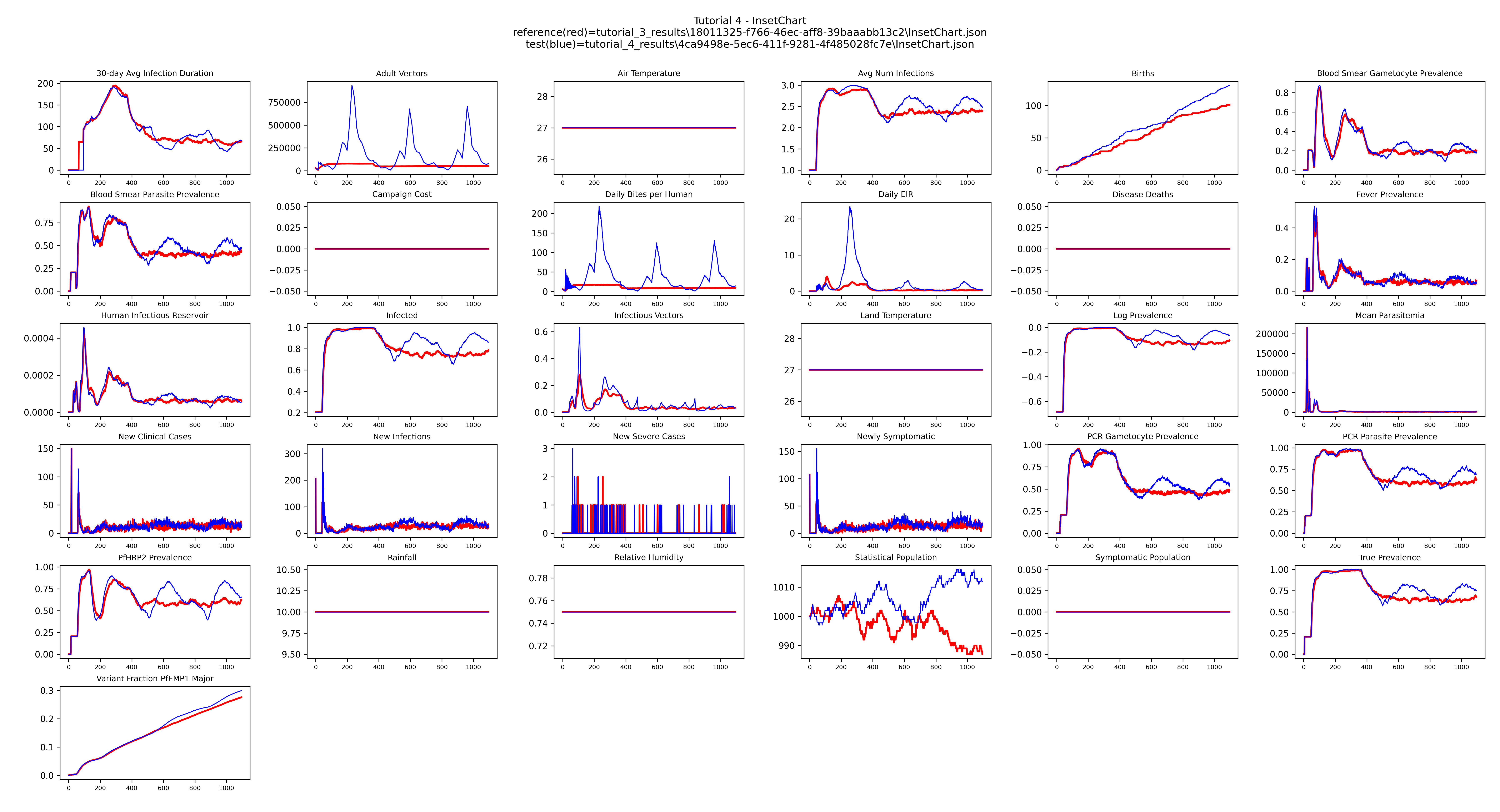
Plotting with a baseline reference
plot_results() looks for tutorial_3_results/ from the previous tutorial and, if found,
uses it as the constant-transmission reference (plotted in red) so the seasonal signal stands
out directly against the flat baseline. If you are starting here without having run Tutorial
3, the plot will still work — the reference line simply will not appear.
plot_inset_chart(dir_name=output_path,
                 reference=reference,
                 title="Tutorial 4 - InsetChart",
                 output=output_path)
The flat lines from Tutorial 3 become wave-shaped seasonal cycles, with transmission rising and falling each year in step with the habitat scaling curve.
Example output
Next
Tutorial 5 introduces parameter sweeps with SimulationBuilder, running
multiple simulations across a range of treatment-seeking coverage values.