Tutorial 4: Override the cascade of care
This tutorial shows how to customize the HIV cascade of care by subclassing a country model and overriding one of its cascade state methods.
File: tutorials/tutorial_4_overriding_coc.py
The country model and cascade of care
Each country model has a build_campaign() method that constructs the cascade of care — the
series of states representing testing, diagnosis, linkage to care, ART staging, and treatment.
The cascade is built by calling a set of add_state_* class methods, each of which adds one
state. To customize the cascade, subclass the country model and override one or more of those
methods.
Subclassing the country model
MyZambia subclasses ZambiaForTraining and overrides add_state_HCTUptakeAtDebut:
class MyZambia(ZambiaForTraining):
    country_name = 'MyZambia'

    @classmethod
    def add_state_HCTUptakeAtDebut(cls, campaign, start_year, node_ids=None):
        ...
All other cascade states are inherited unchanged from ZambiaForTraining.
What the baseline state does
The baseline HCTUptakeAtDebut state listens for the STIDebut event, which is broadcast
when a person first seeks sexual relationships. When triggered, it uses a sigmoid distribution
to determine the probability that the person enters the testing loop or waits and reconsiders
later.
What the override does
The override runs the baseline sigmoid logic only for the first 35 years (1990–2025). Starting in 2025, when a person debuts sexually they first receive a long-acting PrEP intervention before going through the same sigmoid decision:
# Run baseline sigmoid logic for 35 years (expires in 2025)
duration = 35 * 365
add_intervention_triggered(campaign,
                           intervention_list=[uptake_choice],
                           triggers_list=[coc.CustomEvent.STI_DEBUT],
                           start_year=start_year,
                           duration=duration)

# Starting in 2025: distribute LA-PrEP at debut, then broadcast an event
# that triggers the same sigmoid decision
laprep = ControlledVaccine(campaign, waning_config=MapPiecewise(...), ...)
broadcast_sigmoid = BroadcastEvent(campaign, sigmoid_event)

add_intervention_triggered(campaign,
                           intervention_list=[laprep, broadcast_sigmoid],
                           triggers_list=[coc.CustomEvent.STI_DEBUT],
                           start_year=laprep_start_year)

# Apply the same sigmoid decision when the broadcast event is heard
add_intervention_triggered(campaign,
                           intervention_list=[uptake_choice],
                           triggers_list=[sigmoid_event],
                           start_year=laprep_start_year)
Notice that uptake_choice is defined once and reused in both the pre-2025 and post-2025
listeners. In JSON this configuration would need to be duplicated — using Python avoids that
and keeps the logic consistent.
Using the subclassed model
The build functions replace ZambiaForTraining with MyZambia:
def build_config(config):
    zambia = MyZambia
    config = zambia.build_config(config)
    ...

def build_campaign(campaign):
    zambia = MyZambia
    zambia.build_campaign(campaign)
    ...
When MyZambia.build_campaign() is called, Python's method resolution automatically picks
up the overridden add_state_HCTUptakeAtDebut — no other changes to the build functions
are required.
The rest of the script — sweeping Run_Number, running the experiment, downloading results,
and plotting — is the same as Tutorial 3. Results are saved to tutorial_4_results/.
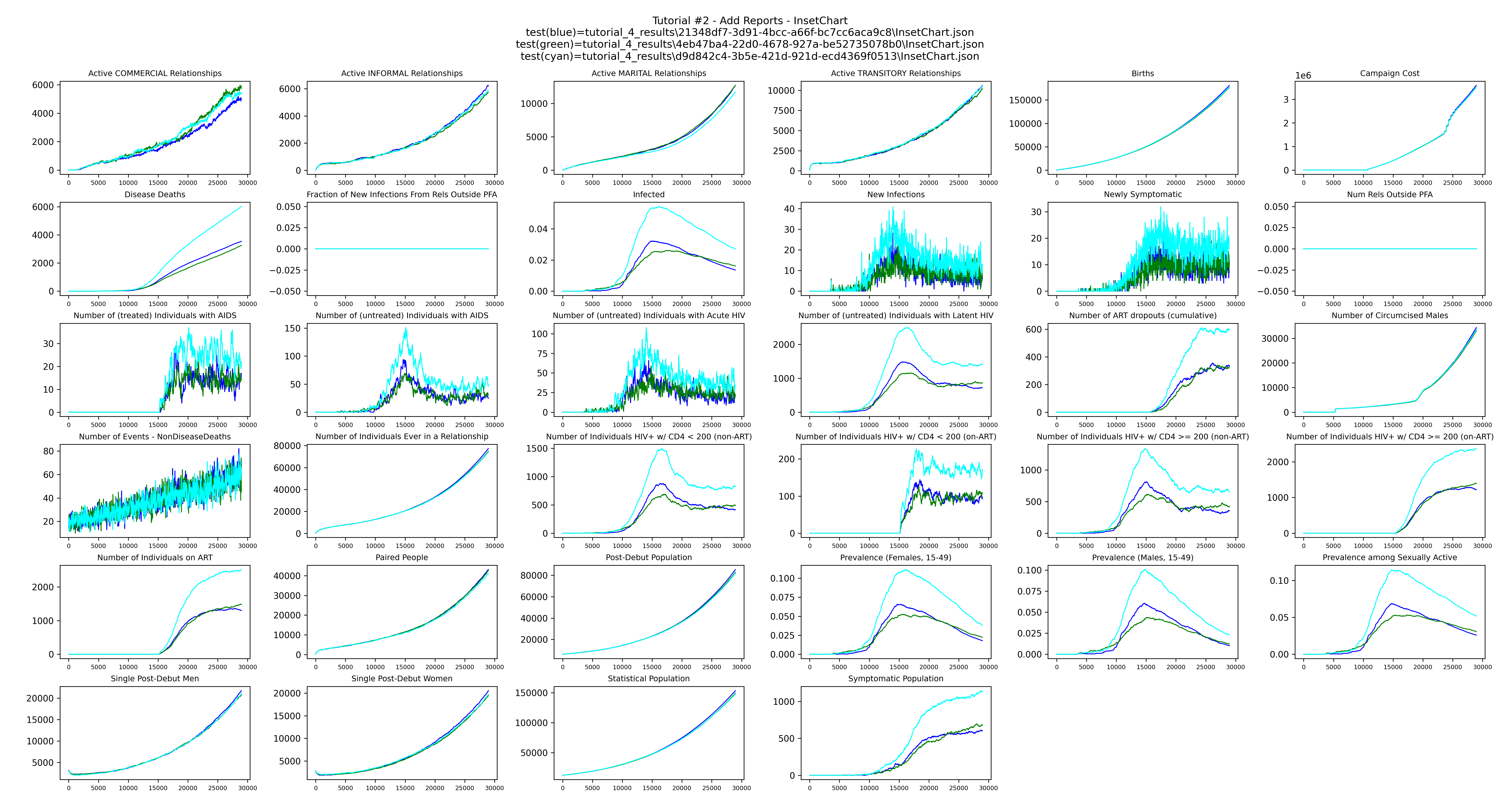
plot_inset_chart produces a grid of all channels from the InsetChart.json of each run,
with one line per realization, giving a quick overview of the simulation over time:
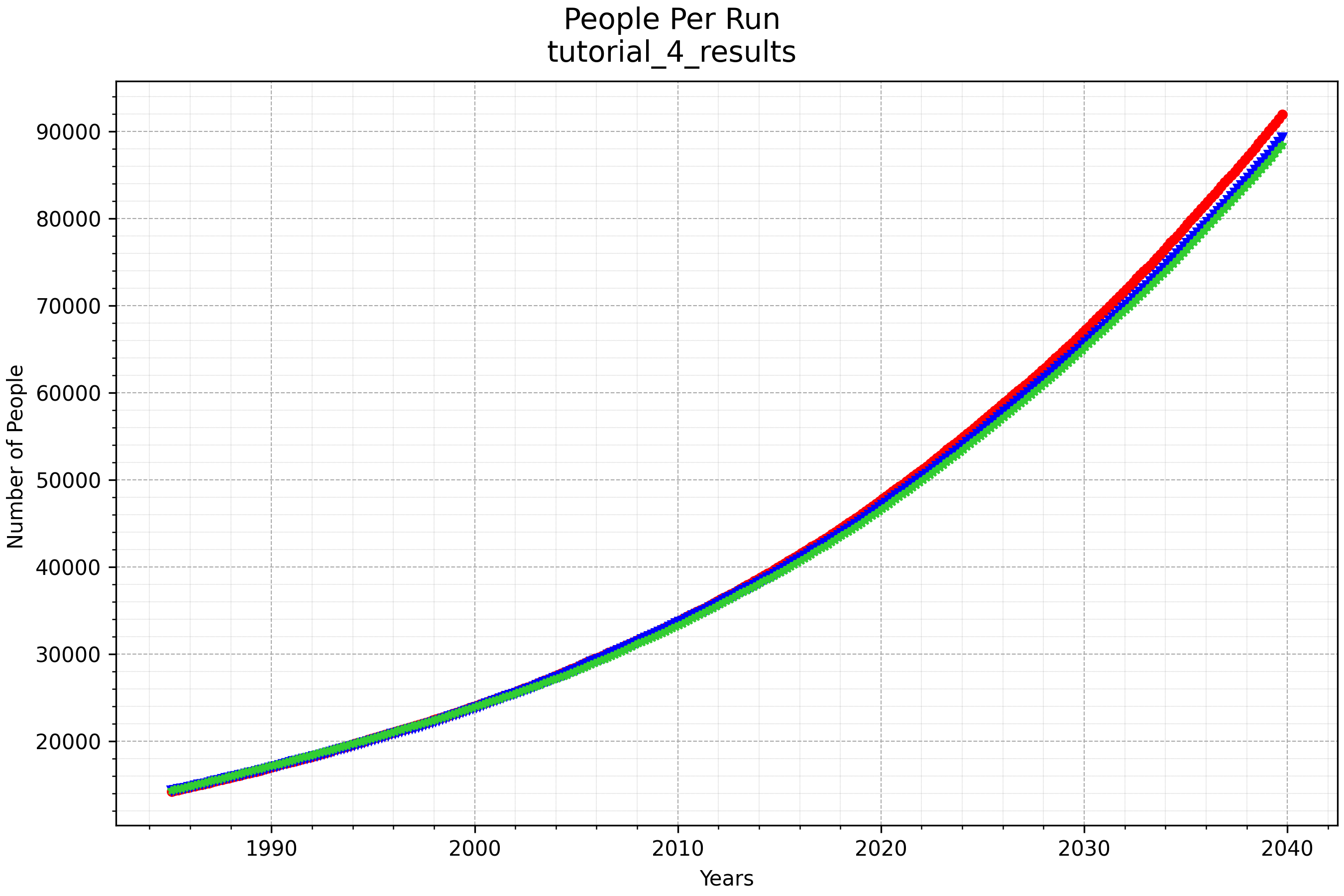
plot_population_by_age shows the population over time for each run:
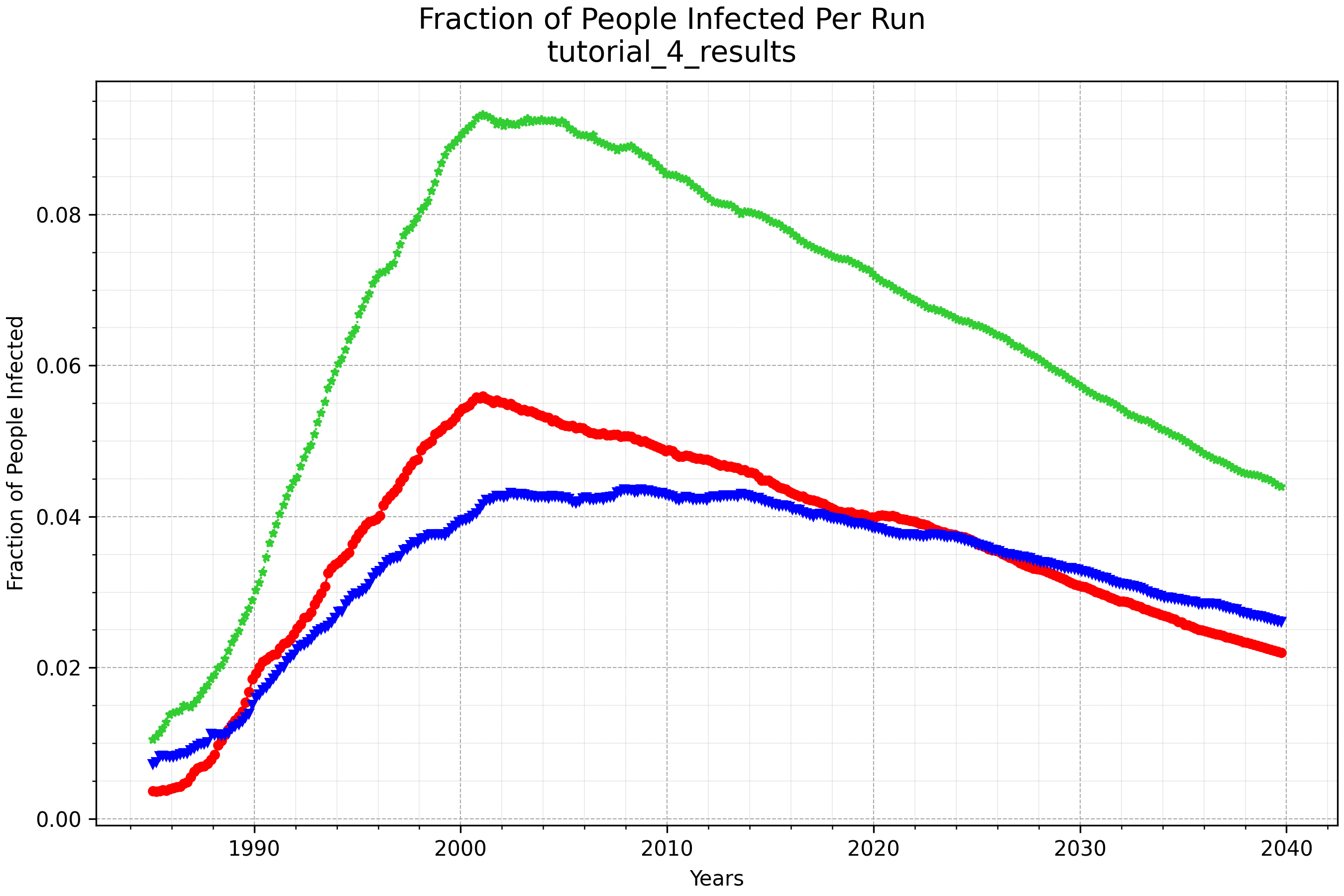
plot_prevalence_for_dir shows the fraction of the population infected with HIV over time
for each run:
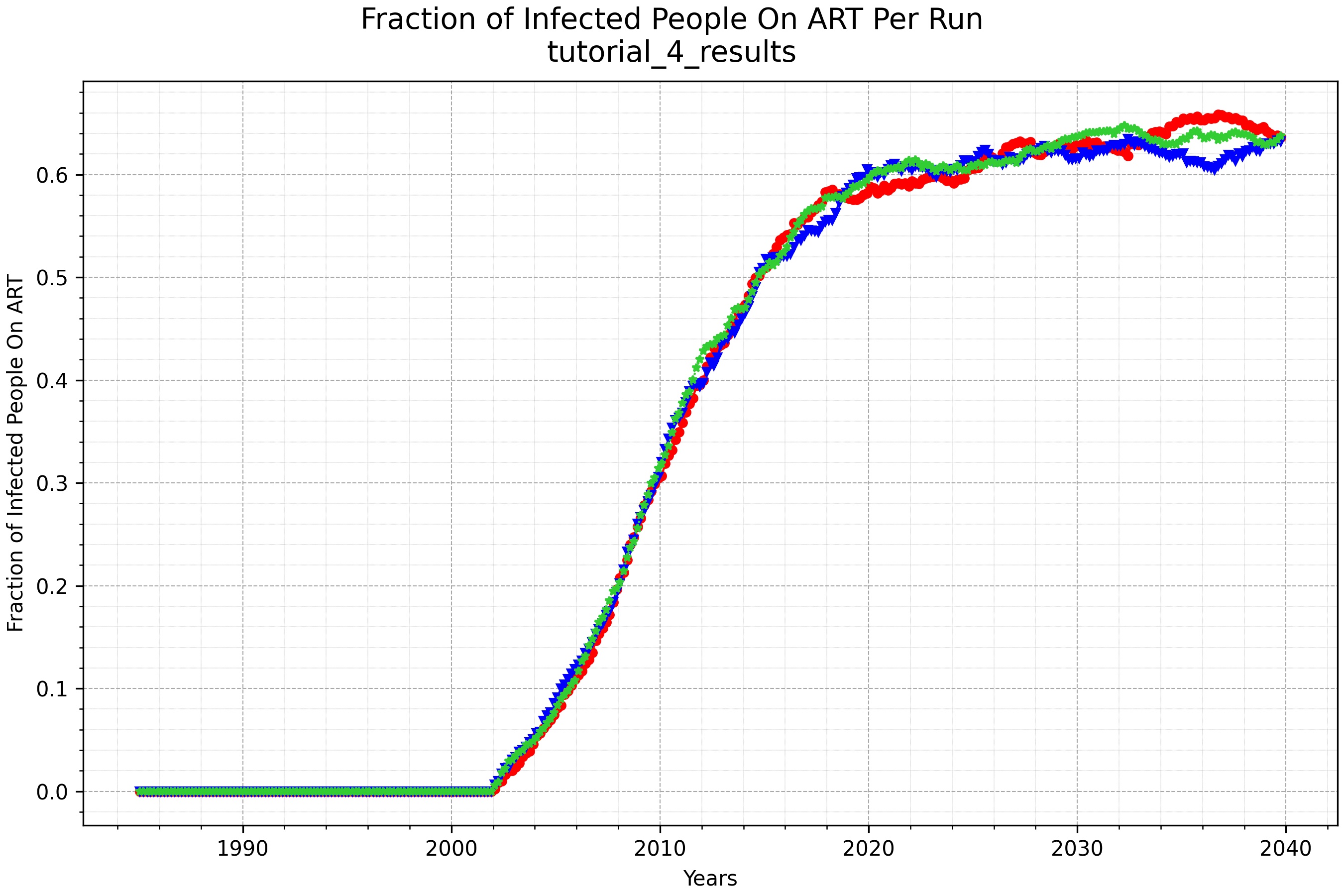
plot_onART_by_age shows the fraction of infected people on ART over time for each run: